
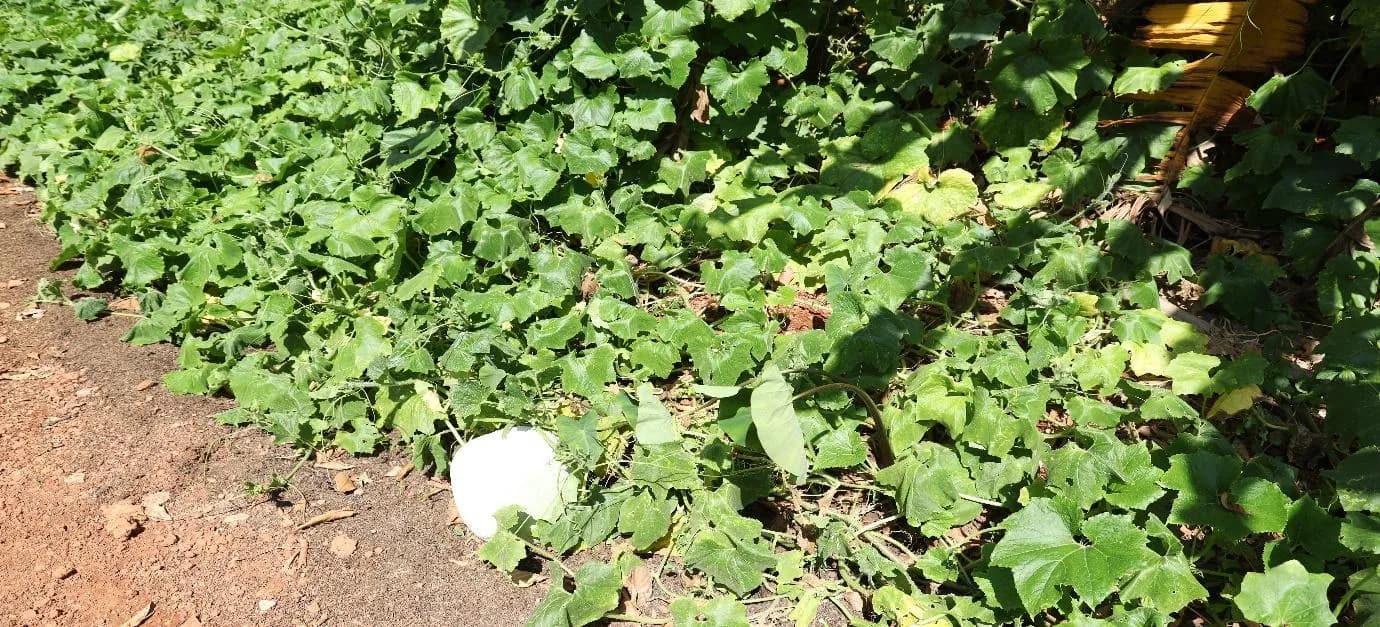
Ash Gourd
Benincasa hispida (Thunb.) Cogn.
Location
Vegetable Garden
Family
Cucurbitaceae
Common names
Ash Gourd, Kumbala kai
Native range
South and Southeast Asia
Habitat
Cultivated in gardens and farms
Flowering
April to May
Fruiting
3 to 6 months after flowering
Conservation status
Not of concern; widely cultivated
About this plant
Benincasa hispida has large, roughly lobed five-part leaves approximately 10–25 cm wide. It produces yellow, five-petaled flowers mainly in early summer. The fruit is large, melon-like, oblong to round, initially covered with soft hairs which disappear at maturity, revealing a waxy surface. The mature fruit flesh is white, firm, and crisp, suitable for cooking or storage.
Uses
The fruit is widely consumed as a vegetable when young and used in various culinary dishes when mature. In traditional medicine, it is valued for its cooling and digestive properties. It is used as a tonic, diuretic, and remedy for digestive disorders, inflammation, and fever. Rich in antioxidants and vitamins, it supports health and wellness in Ayurvedic and folk medicine systems.
Growing conditions
Prefers warm tropical to subtropical climates, requires well-drained soils, and grows best in full sun. The vine can trail on the ground or be trained on supports. Flowering occurs mainly between April and May, with fruit harvesting possible within 3 to 6 months after sowing
Habit
Trailing or climbing annual vine