
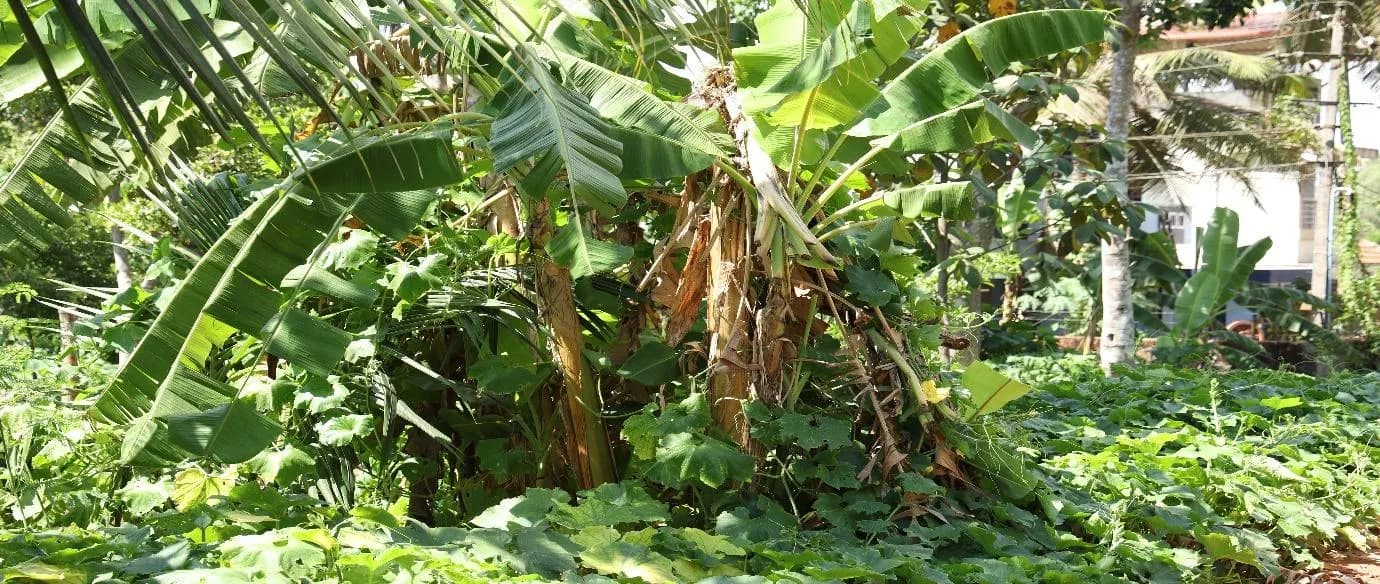
Banana
Musa paradisiaca L. (cultivated hybrid species)
Location
Vegetable Garden
Family
Musaceae
Common names
Banana, Plantain
Native range
Southeast Asia (including India and Malaysia)
Habitat
Tropical lowland regions
Flowering
8–10 months after planting
Fruiting
12–15 months after planting; harvested once per plant
Conservation status
Not Evaluated
About this plant
The banana plant is a robust, herbaceous plant that can grow up to 3–6 meters tall. It has a pseudo stem formed by tightly packed leaf bases, with large, broad leaves arranged in a spiral. The inflorescence emerges from the centre of the pseudo stem, bearing both male and female flowers. Fruits develop in clusters(hands), are long, curved, and vary in size and colour depending on the cultivar. Bananas are parthenocarpy—formed without fertilization and hence seedless in edible varieties.
Uses
In the Karavali region, the banana (called "Baale hannu" in Kannada and Tulu) is a culturally and culinarily significant plant. Banana leaves are traditionally used as eco-friendly plates during festivals and feasts. The stem and flower (banana blossom) are also cooked in traditional curries and stir-fries.
Growing conditions
Requires a warm, humid climate with good rainfall or irrigation. Prefers fertile, well-drained loamy soils rich in organic matter. Grows well in full sunlight and needs protection from strong winds. Regular fertilization and moisture are essential for high yields
Habit
Large, fast-growing, herbaceous perennial