
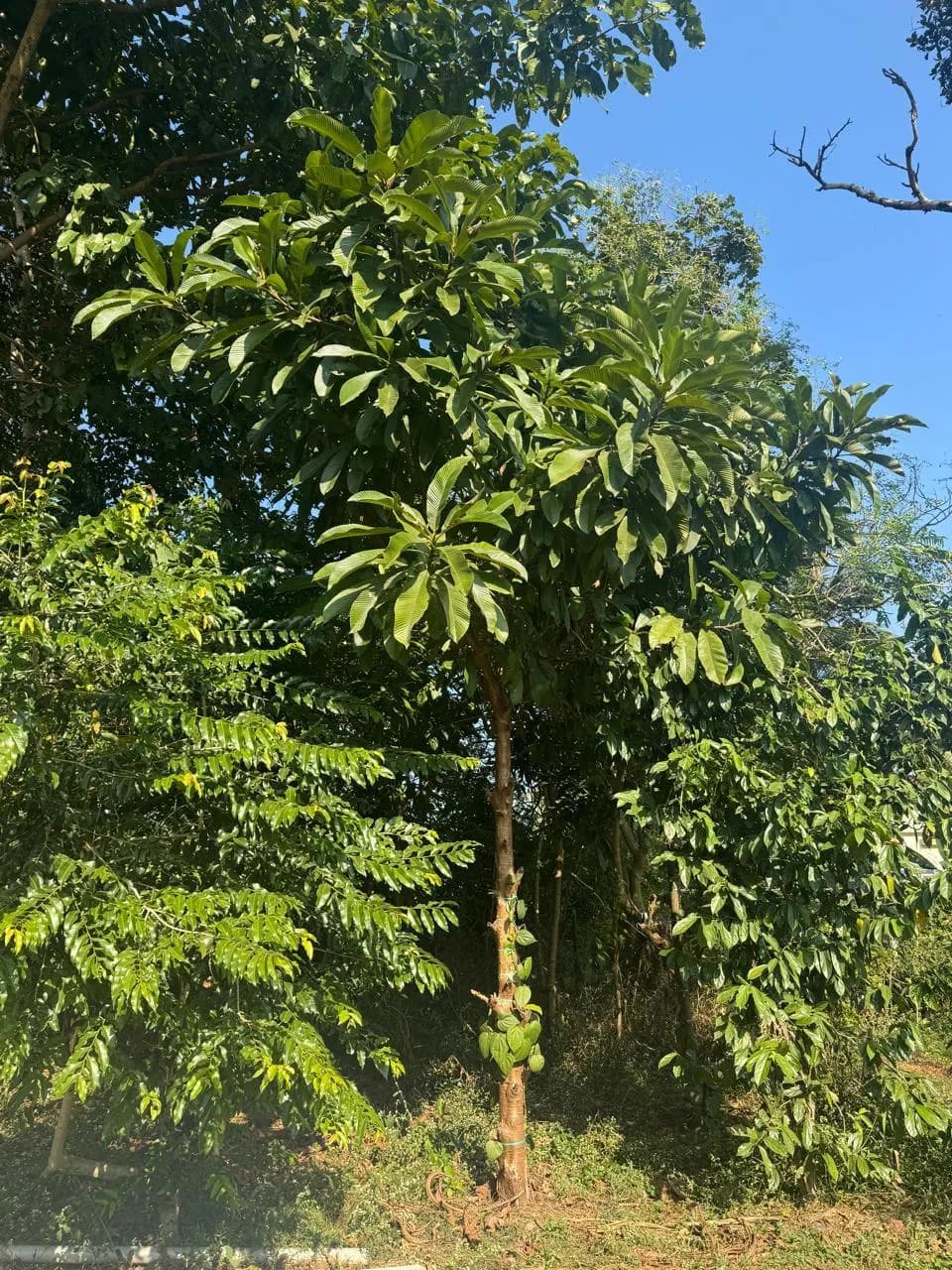
Five-leaved Dillenia
Dillenia pentagyna Roxb.
Location
Botanical Garden
Family
Dilleniaceae
Common names
Five-leaved Dillenia, Muchchire
Native range
Indian subcontinent and Southeast Asia
Habitat
Tropical and subtropical deciduous forests
Flowering
Flowering generally occurs during late spring to early summer, often before or with the emergence of new leaves.
Fruiting
Fruiting follows in the monsoon and post-monsoon season.
Conservation status
Not globally threatened, but local populations may be affected by deforestation and habitat degradation
About this plant
Dillenia pentagyna is a medium-sized deciduous tree growing up to 15–20 metres in height. The bark is greyish-brown, rough, and exfoliating in thin flakes. Leaves are simple, alternate, oblong to elliptic, large, and leathery with prominently serrated margins and distinct parallel lateral veins. Flowers are large, solitary or in small clusters, white to pale yellow, and showy, with numerous stamens. Fruits are globose, green turning yellowish when mature, with a hard outer surface and persistent sepals forming a crown-like structure. Seeds are numerous and embedded in a fibrous pulp.
Uses
The fruit pulp is edible and has a sour taste; it is sometimes used in traditional dishes and beverages. In folk medicine, various parts of the plant—bark, leaves, and fruits—are used for treating diarrhea, fever, wounds, inflammation, and digestive disorders. The tree also has cultural importance in some regions and is valued for its timber and shade.
Growing conditions
Thrives in full sun to partial shade and prefers well-drained, fertile loamy soils. It is adapted to seasonal dry conditions and grows well in deciduous forest climates. Moderately drought-tolerant once established. Sensitive to prolonged waterlogging
Habit
Medium-sized deciduous tree