
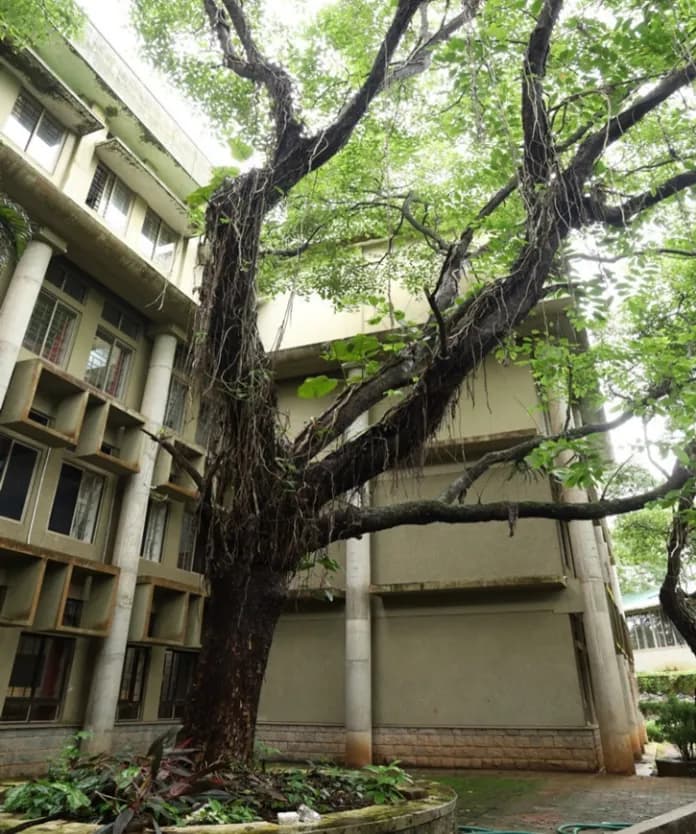
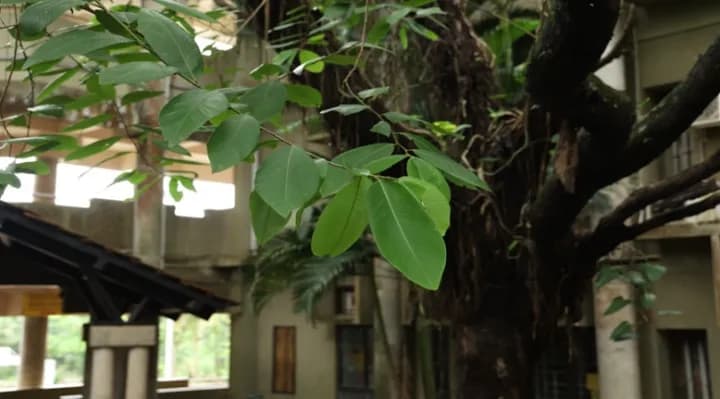
Spinous Kino Tree
Bridelia retusa (L.) A. Juss.
Location
Administrative Block 1
Family
Phyllanthaceae
Common names
Spinous Kino Tree, Asan (आसंद in Hindi, असाणा in Marathi)
Native range
South and Southeast Asia, including the Indian subcontinent, China, Indo-China, and Malesia
Habitat
Usually found in moist and dry deciduous forests, along riverbanks, on rocky ground, and on hill slopes, often up to about 1,000 m elevation. It commonly occurs in forested areas, particularly in valleys and near streams.
Flowering
July – December
Fruiting
August – December
Conservation status
Not threatened; commonly found in the wild and well adapted to diverse habitats
About this plant
Leaves are simple, elliptic to oblong, leathery, bright green and glabrous on the upper surface, paler and slightly hairy beneath, measuring 4.5–10 × 2.7–11.5 cm, with prominent venation. The tree bears small, creamy-white flowers arranged in terminal panicles. Fruits are small drupes, green when young and turning yellowish-red to purple-black at maturity, seated on an enlarged calyx.
Uses
Bark and roots are valued in traditional medicine for treating rheumatism, viral infections, and snake bites. Leaves are used as cattle fodder. The wood is durable, and the bark yields dye and tannins. Ripe fruits are edible and occasionally consumed locally.
Growing conditions
Prefers full sunlight and thrives in moist, well-drained soils but adapts well to a wide range of conditions, including rocky and sandy soils. Propagates readily through seeds or softwood cuttings
Habit
Medium-sized, fast-growing deciduous tree, typically reaching 8–15 m in height. The trunk is often armed with spines, and the bark is grey to blackish-brown and fissured.