
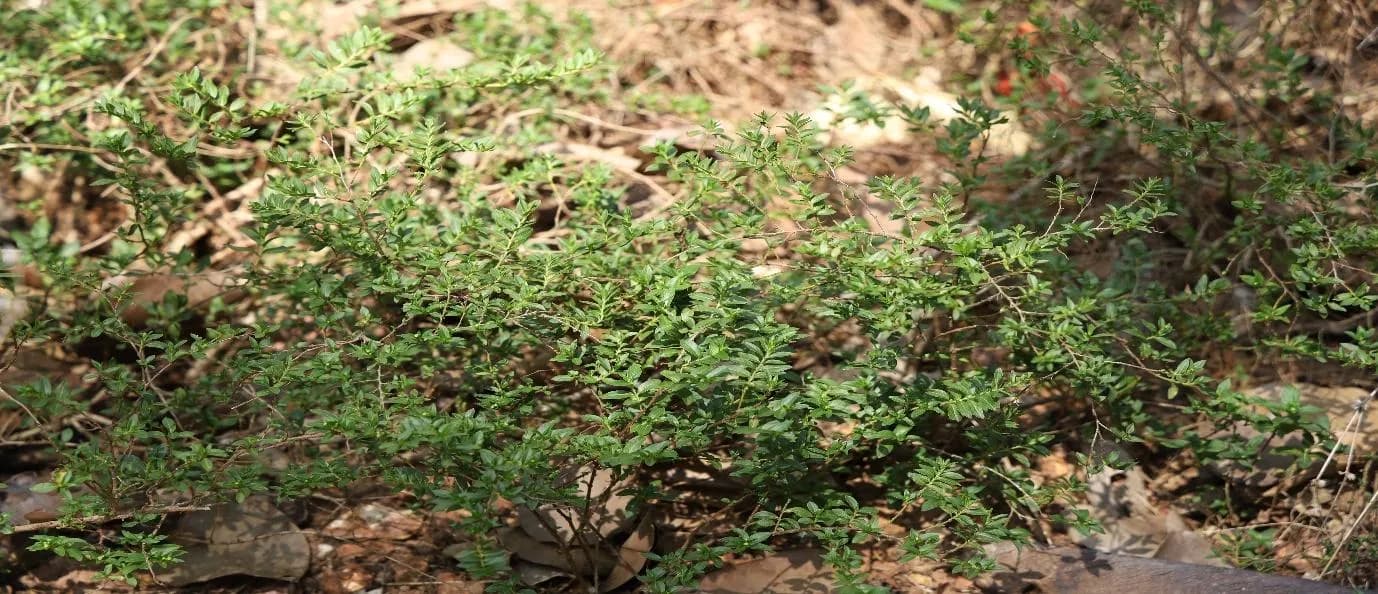
Mexican heather
Cuphea hyssopifolia Kunth
Location
Butterfly Garden
Family
Lythraceae
Common names
Mexican heather, False heather, Hawaiian heather
Native range
Mexico and Central America
Habitat
Gardens, roadsides, open scrublands, disturbed sites
Flowering
Nearly year-round in tropical regions, with peak flowering from spring to autumn
Fruiting
Occurs shortly after flowering; fruiting is often inconspicuous and continuous in warm climates
Conservation status
Not threatened; widely cultivated and naturalized in many tropical and subtropical regions, sometimes escaping cultivation but not considered invasive in most areas
About this plant
Cuphea hyssopifolia is a compact, finely textured shrub with numerous slender, glabrous to sparsely pubescent branches. Leaves are small, narrow-lanceolate to elliptic, opposite, entire-margined, and dark green, giving the plant a heather-like appearance. Flowers are small, tubular, and axillary, borne singly or in pairs along the stems. The corolla is typically lavender, purple, pink, or white, with six small lobes and protruding stamens. The calyx is elongated and green, persisting around the fruit. The fruit is a small dry capsule containing several tiny seeds.
Uses
Mexican heather is primarily grown as an ornamental plant for borders, hedges, pots, and ground cover due to its long flowering period. In traditional medicine, especially in parts of Mexico, it has been used as a mild herbal remedy for fever, inflammation, and digestive discomfort, though these uses are less widespread and mostly folkloric.
Growing conditions
Prefers tropical to subtropical climates and grows best in well-drained loamy or sandy soils. It thrives in full sun to partial shade, with better flowering in full sun. The plant is tolerant of pruning, light drought, and urban conditions, making it suitable for landscaping. Moderate watering is required, and it does not tolerate frost
Habit
Low-growing, much-branched evergreen shrub or subshrub