
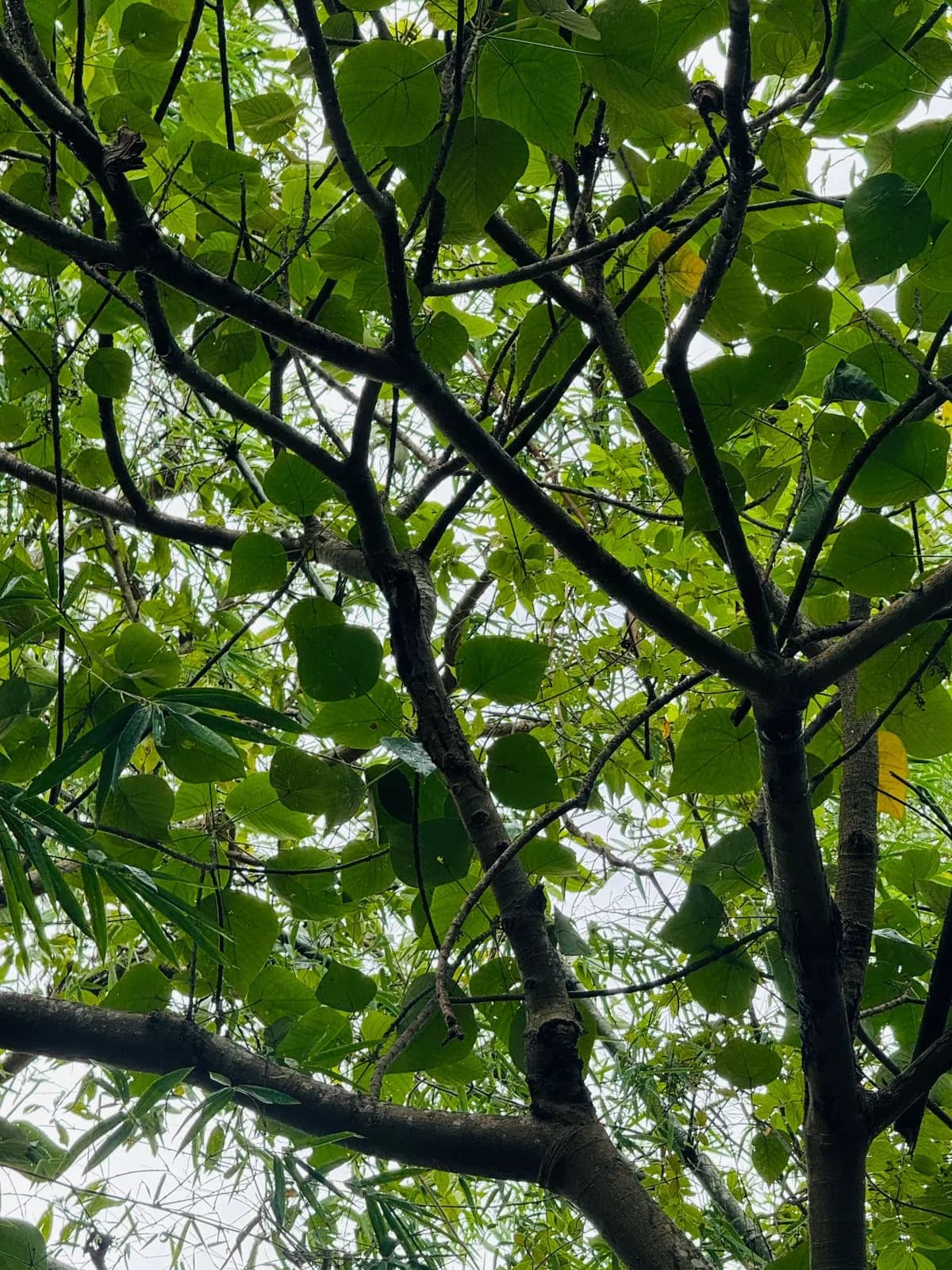
Macaranga
Macaranga peltata (Roxb.) Müll.Arg.
Location
Main Gate & Parking
Family
Euphorbiaceae
Common names
Macaranga, Mallotus Macaranga, Chandada, Uppaliga
Native range
Indian subcontinent and Southeast Asia, including Sri Lanka, Western Ghats, and the Karavali region
Habitat
Moist deciduous forests and tropical rainforests. Common along forest edges, clearings, secondary growth areas, and disturbed sites
Flowering
January - March
Fruiting
April - June
Conservation status
Least Concern (LC)
About this plant
This plant typically grows to a height of about 5–10 meters and is soft-wooded, with a straight trunk and a broad crown. The leaves are large and almost circular (peltate), measuring 10–30 cm across, with long stalks attached near the center of the leaf, giving a lotus-leaf appearance. The flowers are small, yellowish, and borne in terminal clusters; the species is dioecious, with male and female flowers occurring on separate trees. The fruits are small, three-lobed capsules with a spiny surface, containing small seeds.
Uses
The bark and leaves are commonly used in traditional remedies to treat cuts, swellings, and various skin ailments. The wood is used as fuel and also for making matchsticks and packing materials.
Growing conditions
Prefers moist, well-drained soils. Grows quickly in full sunlight and regenerates rapidly after disturbance. Common in shifting cultivation areas and fallow land
Habit
Small to medium-sized fast-growing tree