
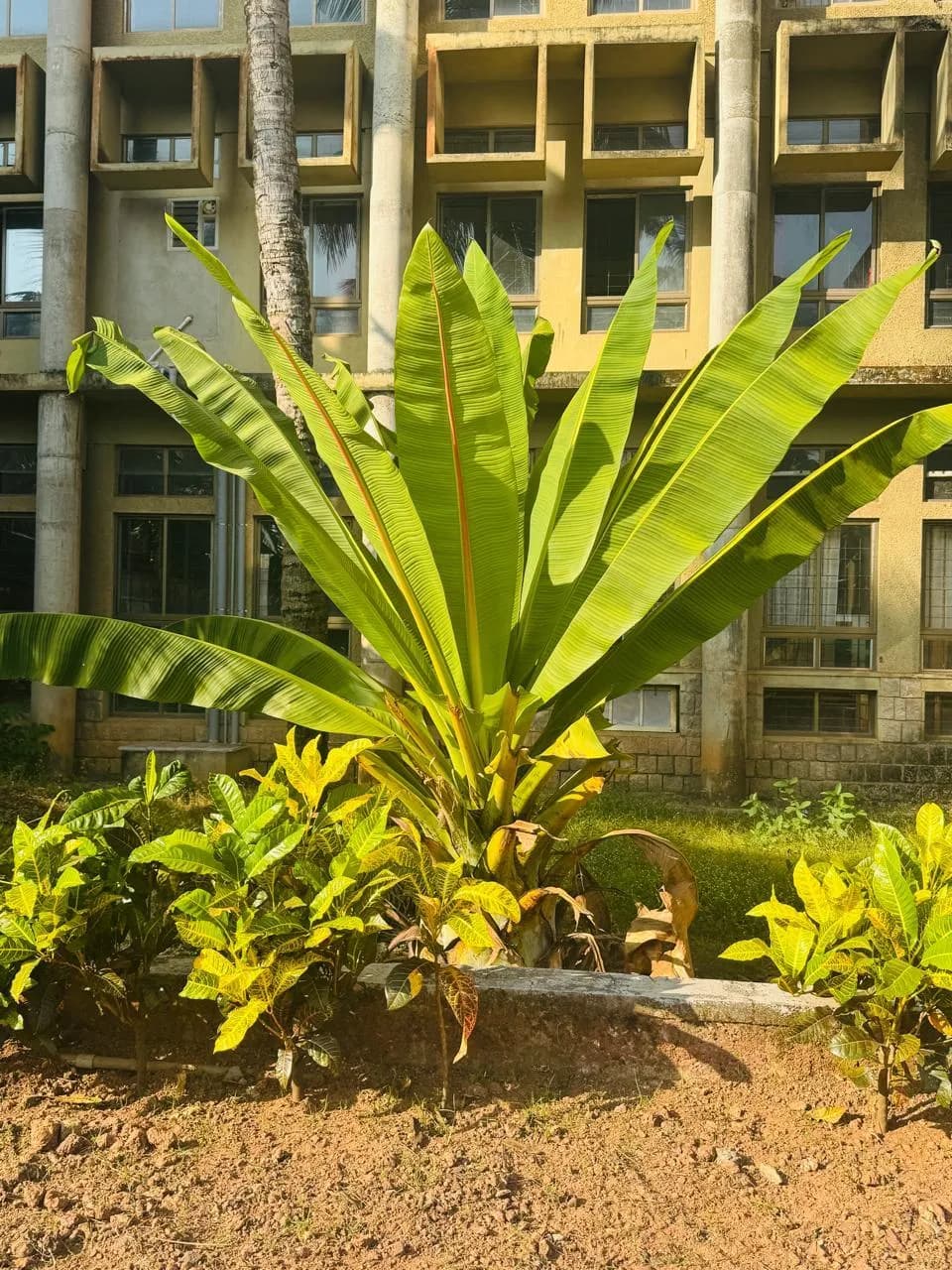
Wild Banana
Ensete superbum (Roxb.) Cheesman
Location
Other Plants
Family
Musaceae
Common names
Wild Banana, Rock Banana
Native range
India (Western Ghats)
Habitat
Tropical and subtropical regions; rocky slopes, forest edges
Flowering
The plant flowers once after several years of vegetative growth (monocarpic), usually during the monsoon or post-monsoon season, after which the plant dies.
Fruiting
Fruiting follows flowering, producing seeded fruits.
Conservation status
Not globally threatened, but considered regionally vulnerable in parts of its native range due to habitat loss and overharvesting for medicinal use
About this plant
Ensete superbum is a robust, monocarpic, perennial herb resembling a banana plant, growing up to 4–6 metres in height. It has a stout pseudostem formed by tightly packed leaf sheaths. Leaves are large, oblong to elliptic, leathery, dark green with prominent midribs, and often show reddish tinges on the margins or underside. The inflorescence is large and erect, with striking reddish-purple bracts. Flowers are unisexual, cream to yellowish, arranged in clusters beneath the bracts. Fruits are oblong, fibrous, and filled with numerous hard black seeds, unlike edible bananas.
Uses
Traditionally, Ensete superbum has been used in folk medicine. Seeds are commonly used in Ayurveda and traditional practices, especially for treating kidney stones, urinary disorders, and digestive problems. The plant is also valued as an ornamental due to its dramatic foliage and inflorescence. Fibres from the pseudostem are sometimes used locally for cordage.
Growing conditions
Thrives in full sun to partial shade and prefers well-drained, fertile soils, often tolerating rocky and marginal soils. Requires moderate watering but is relatively drought-tolerant once established
Habit
Large perennial herb