
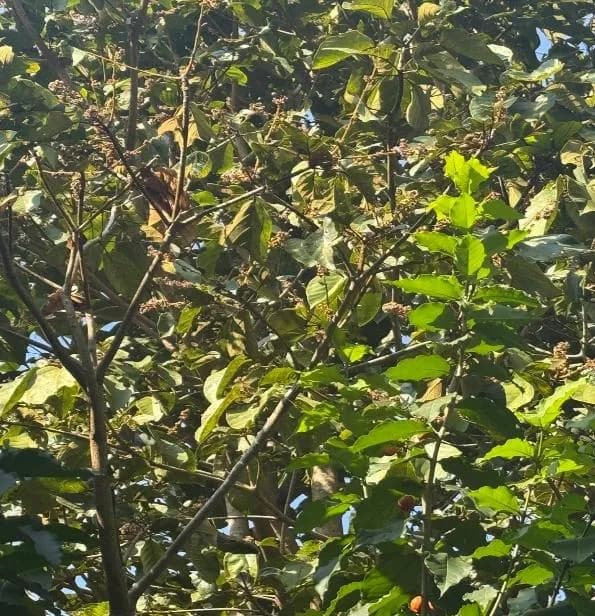
Karaya
Sterculia guttata Roxb.
Location
Botanical Garden
Family
Malvaceae (formerly Sterculiaceae)
Common names
Karaya, Kulu, Indian Tragacanth Tree, Kondagogu
Native range
Indian subcontinent (India, Sri Lanka); parts of Southeast Asia
Habitat
Tropical dry and moist deciduous forests
Flowering
February – April
Fruiting
April – July
Conservation status
Not threatened, though natural populations may be locally affected by overexploitation for gum. Widely cultivated and recommended for dry-zone reforestation and sustainable gum production
About this plant
Sterculia guttata is a large, fast-growing deciduous tree attaining heights of about 20–30 metres, with a broad, spreading crown. The trunk is straight and stout, with grey to pale brown bark that exfoliates in thin flakes. The inner bark exudes a gummy resin when injured. Leaves are large, palmately lobed (3–7 lobes), broadly ovate, leathery, and borne on long petioles. The upper surface is dark green while the underside is paler and slightly hairy. The tree is monoecious, bearing male and bisexual flowers on the same plant. Flowers are small, greenish-yellow to purplish, borne in terminal or axillary panicles. Fruits are woody, boat-shaped follicles, usually occurring in clusters of 3–5, turning reddish-brown when mature. Each follicle splits open to reveal large black seeds covered with irritating hairs.
Uses
Sterculia guttata has local economic importance for its gum, timber, and traditional medicinal uses. The gum obtained from the tree is used in traditional medicine and various industrial applications. In tribal and folk traditions, the bark and leaves are used for wound healing, inflammation, and certain skin ailments. The tree also contributes to rural livelihoods through gum collection. Its wood is soft and is used for light construction, packing cases, and matchboxes.
Growing conditions
Thrives in full sun and prefers well-drained sandy loam to red soils
Habit
Large deciduous tree