
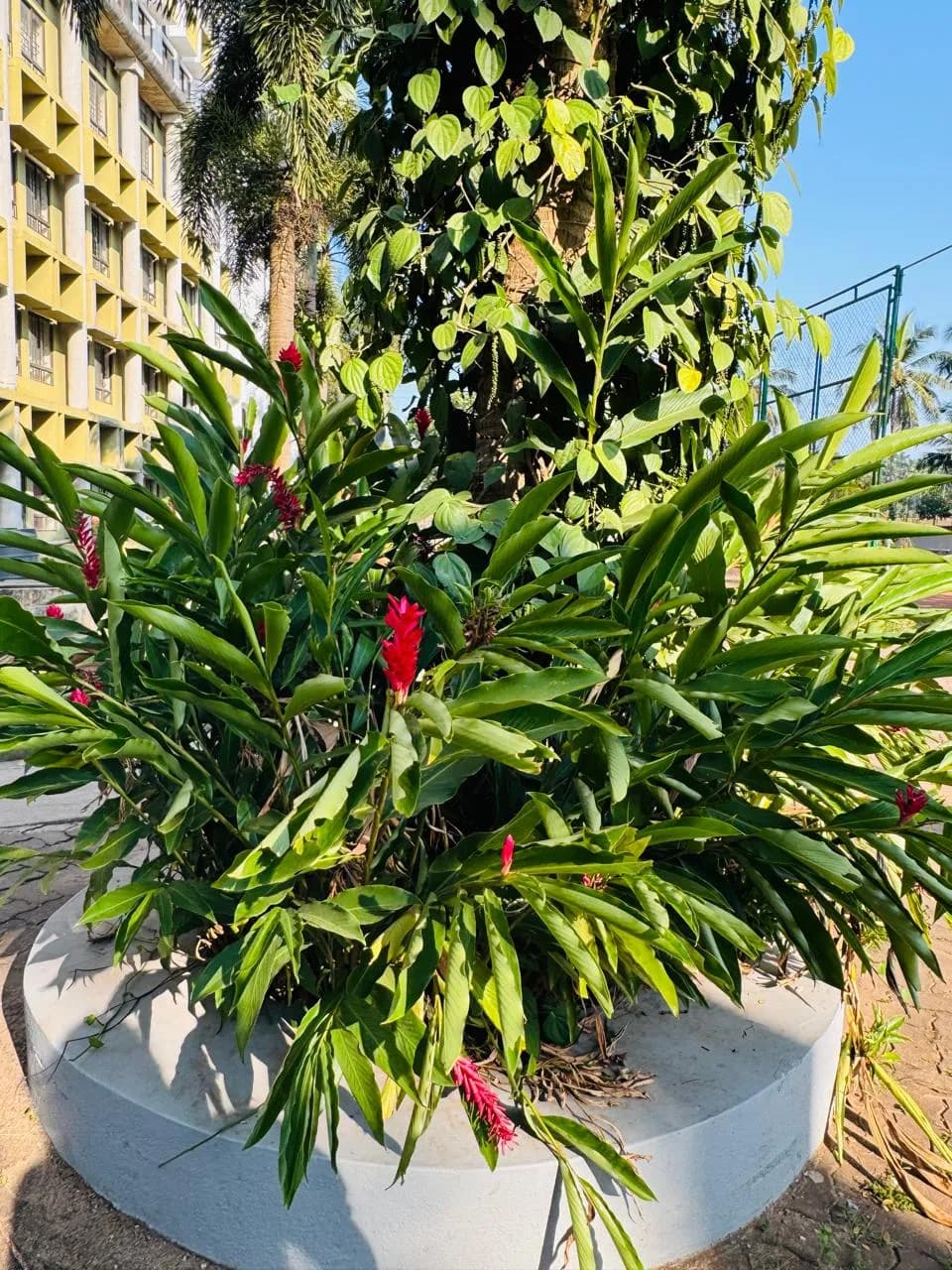
Red Ginger
Alpinia purpurea (Vieill.) K. Schum.
Location
Other Plants
Family
Zingiberaceae
Common names
Red Ginger, Ostrich Plume, Pink Cone Ginger
Native range
Western Pacific Islands (including New Caledonia, Solomon Islands, and nearby regions)
Habitat
Tropical regions, forest margins, and cultivated gardens
Flowering
Intermittently throughout the year.
Fruiting
Intermittently throughout the year.
Conservation status
Not threatened; widely cultivated and naturalized in many tropical and subtropical regions worldwide.
About this plant
Alpinia purpurea is a robust, evergreen, rhizomatous perennial herb that typically grows 2–4 metres tall. It forms clumps of erect, cane-like pseudostems arising from underground rhizomes. Leaves are large, lanceolate to oblong, glossy green, and arranged alternately along the stems, with prominent midribs. The most striking feature is the inflorescence: large, upright, cone-shaped spikes composed of bright red to pink bracts. The true flowers are small, white to yellowish, and emerge briefly from between the bracts. The ornamental bracts persist for a long time, making the plant highly decorative. Fruits are rarely seen in cultivation and are small capsules containing seeds.
Uses
Alpinia purpurea is widely cultivated as an ornamental plant for tropical gardens, landscaping, borders, and as a cut flower due to its long-lasting and vibrant inflorescences. In some traditional systems, the rhizomes and leaves are used in folk medicine for their anti-inflammatory and digestive properties, similar to other members of the ginger family, though its primary value is ornamental rather than medicinal.
Growing conditions
Thrives in warm, humid climates and prefers partial shade to full sun. Grows best in fertile, well-drained, moist soils rich in organic matter. Requires regular watering and does not tolerate drought well. It is sensitive to frost and cold temperatures but responds well to mulching and protection in cooler climates
Habit
Evergreen perennial herb