
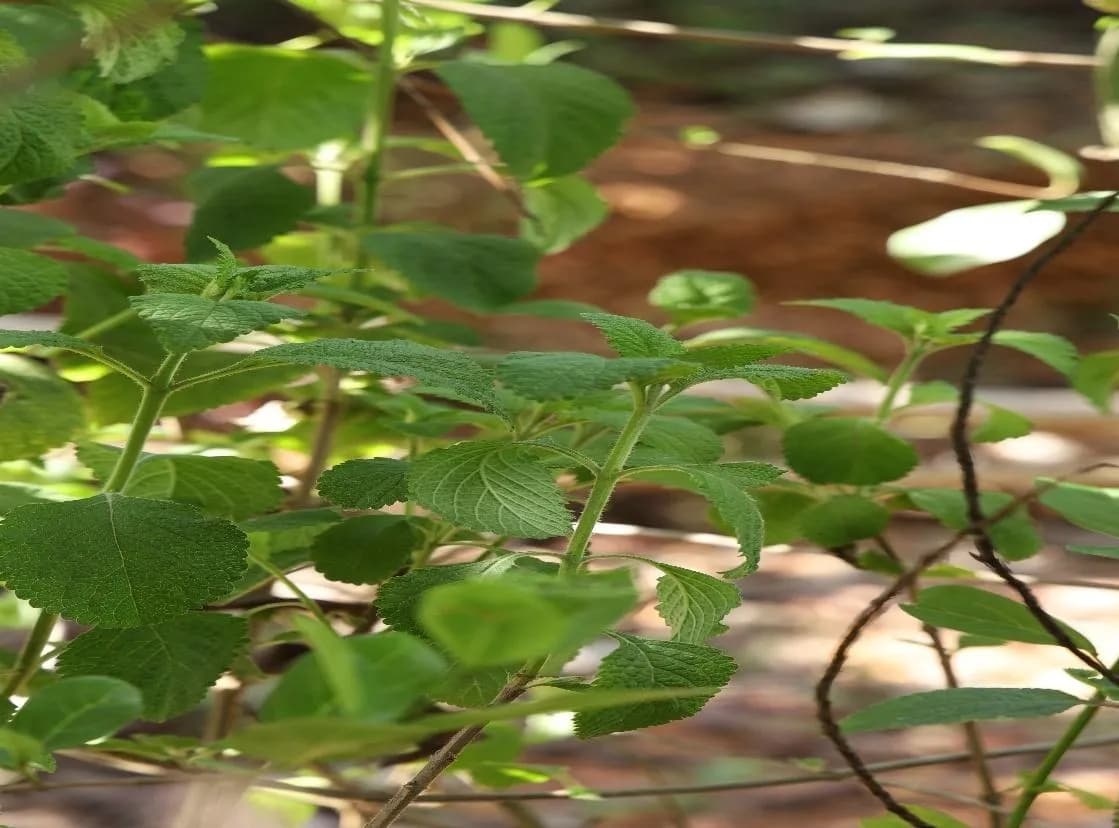
Indian borage
Plectranthus amboinicus (Lour.) Spreng.
Location
Butterfly Garden
Family
Lamiaceae
Common names
Indian borage, Cuban oregano, Country borage, Mexican mint
Native range
Southern and Eastern Africa (widely cultivated in the tropics)
Habitat
Home gardens, roadsides, rocky places, cultivated fields
Flowering
December-March
Fruiting
Rare; vegetative propagation is more common
Conservation status
Not threatened; widely cultivated and naturalized in many tropical regions, sometimes found growing wild near habitations
About this plant
Plectranthus amboinicus is a fleshy, spreading perennial herb with thick, softly pubescent, succulent stems. Leaves are opposite, broadly ovate to orbicular, thick and juicy, with crenate or scalloped margins and a strong oregano-like aroma when crushed. The leaf surface is densely covered with fine hairs. Inflorescence is a terminal or axillary spike or panicle bearing small pale purple to lavender flowers. The calyx is tubular and persistent; the corolla is bilabiate with four didynamous stamens, typical of the mint family. The fruit consists of four small nutlets, though seed formation is rare and the plant commonly propagates vegetatively.
Uses
Indian borage is widely used as a culinary herb and traditional medicine plant. Leaves are used to flavour soups, meats, and chutneys. Medicinally, it is used for coughs, colds, asthma, bronchitis, digestive disorders, flatulence, and skin infections. Leaf juice mixed with honey is a common home remedy for respiratory ailments in South Asia. It also exhibits antimicrobial, anti-inflammatory, and carminative properties.
Growing conditions
Prefers warm tropical to subtropical climates and grows best in well-drained sandy or loamy soils. Thrives in full sun to partial shade and is drought-tolerant once established. Excess water should be avoided as it may cause root rot. The plant is easily propagated through stem cuttings and responds well to regular pruning
Habit
Succulent, aromatic perennial herb