

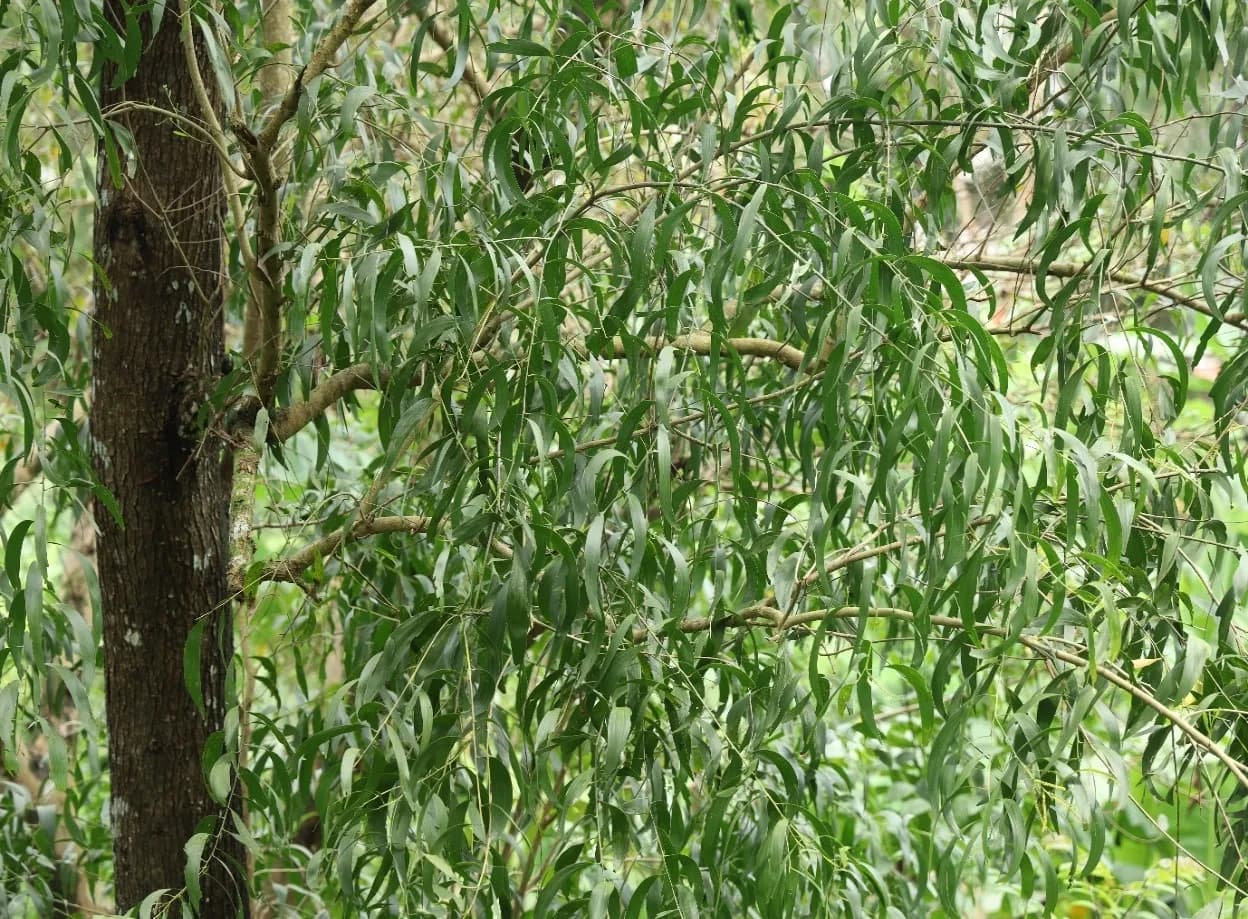
Earleaf Acacia
Acacia auriculiformis A. Cunn. ex Benth.
Location
Civil New Block
Family
Fabaceae (formerly Mimosaceae)
Common names
Earleaf Acacia, Earpod Wattle, Auri, Karuvel, Akashmani
Native range
Australia (Queensland and Northern Territory), Papua New Guinea, and Indonesia
Habitat
Occurs naturally in seasonally dry tropical lowlands, riparian zones along rivers, open forests, savannah woodlands, and swamps. It is adapted to a wide range of soils, including sandy, loamy, clayey, acidic, alkaline, and saline soils, and is often found near watercourses and coastal plains.
Flowering
Occurs mainly during warm seasons and may vary with climate.
Fruiting
Follows the flowering period.
Conservation status
Least Concern (LC); widely planted and naturalized in tropical regions worldwide
About this plant
Leaves are alternate, simple, and phyllode-like, narrowly elliptic, measuring about 6–15 cm in length. The tree produces yellow to golden-yellow slender cylindrical flower spikes. Seed pods are curved or spirally coiled, turning brown when mature and containing hard seeds. It is fast-growing and has a deep root system.
Uses
Widely planted for timber, firewood, pulpwood, and soil improvement due to its nitrogen-fixing ability. It is commonly used in agroforestry and reforestation programs and also provides fodder and habitat for wildlife.
Growing conditions
Prefers full sunlight and is tolerant of drought as well as a wide range of soil pH, from acidic to alkaline. The species is well adapted to hot, humid, and sub-humid tropical climates with annual rainfall ranging from 700 to 2,500 mm. It is sensitive to frost but can tolerate light frost outside its native range
Habit
An evergreen tree typically growing 8–20 meters tall, occasionally reaching 25–35 meters under favourable conditions. It has a straight bole, often multi-stemmed, with rough to smooth grey or brown bark that becomes fissured with age.