
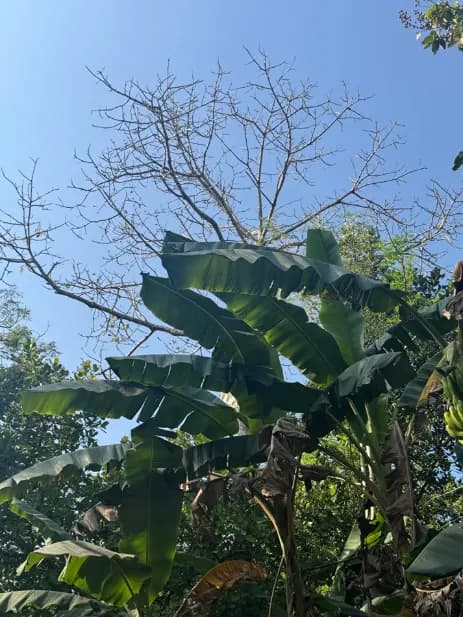
Kapok
Ceiba pentandra (L.) Gaertn.
Location
Botanical Garden
Family
Malvaceae (formerly Bombacaceae)
Common names
Kapok, Silk Cotton Tree, Java Cotton
Native range
Tropical Americas and West Africa; widely cultivated in Southeast Asia
Habitat
Tropical lowland forests, riverbanks, and secondary forests
Flowering
March-June
Fruiting
March-June
Conservation status
Least Concern (LC) Not globally threatened; widely cultivated and naturalized in tropical regions. Some local populations are affected by deforestation
About this plant
Ceiba pentandra is a massive deciduous tree, growing up to 60–70 metres in height with a wide, spreading crown. The trunk is thick and buttressed at the base; bark is greyish and smooth to rough with conical spines when young. Leaves are palmate, compound, with 5–7 leaflets, glossy green, and clustered at branch tips. Flowers are large, showy, creamy-white to pinkish, with a pleasant fragrance, borne at the ends of branches. Fruits are large, woody capsules containing seeds embedded in fluffy, white kapok fibers. Seeds are small, brown, and oval.
Uses
Economic uses: Kapok fibers are light, buoyant, and water-resistant, used for stuffing mattresses, pillows, life jackets, and insulation. Seeds yield oil used in cooking and industry. Timber is lightweight and used in plywood, carvings, and canoes. Medicinal uses: Various parts of the tree (bark, leaves, seeds) are used in traditional medicine to treat fever, dysentery, respiratory issues, and inflammation. Cultural uses: Often considered sacred in many tropical cultures and planted near villages or temples.
Growing conditions
Thrives in full sun and deep, well-drained soils. Tolerates tropical heat and seasonal flooding but prefers humid, tropical climates. Grows rapidly in fertile soils but is sensitive to prolonged frost
Habit
Large deciduous tree